Have any questions? Call us:

Competitor Price Monitoring

Collect data on competitors’ prices, availability, and promotions across all sales channels. Detect price changes on the same day and respond before you lose your margin.

Track product prices on marketplaces, price comparison sites, and online stores—with no limit on the number of sources

99% data accuracy — matching + QA verification, same-day alerts

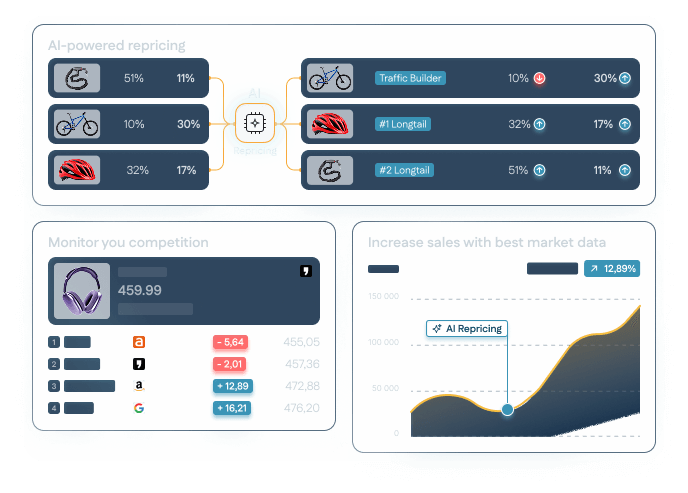
Built-in AI-powered repricing — from price monitoring to automated pricing decisions

How competitor price monitoring works

1

Collecting and matching

Online stores, marketplaces, and price comparison sites tailored to your product catalog.

2

Analysis and alerts

Monitoring on your schedule — alerts flag significant price changes.

3

AI-powered repricing

AI rules and recommendations keep margins and pricing at the appropriate level.

4

Reporting and Integration

Dashboards, exports, and APIs/feeds for your BI or ERP system.

Price Monitoring + Repricing AI

Price monitoring gives you an overview of the market. Repricing AI turns that overview into action—automatically adjusting prices within your rules and limits. Combining these two modules creates a pricing strategy based on data, not gut feelings.

Full transparency – A clear, intuitive dashboard for tracking results

Raport Google Shopping Price Monitoring — przykładowy dashboard z danymi cenowymi

Benefits of monitoring competitor prices

Find out how monitoring, alerts, AI, and data quality translate into higher margins.

A comprehensive overview of the market

Prices, availability, and promotions from all key channels—all in one place.

Instant price alerts

Get notified when prices or availability change—act before your competitors do.

Protection of MAP/MSRP and brand image

Enforce your pricing policy and detect unauthorized price reductions across all channels.

Time savings for the team

Automated monitoring and reporting — Your team can focus on strategy, not data collection.

Top-quality data

Clean, accurate, and regularly updated data you can rely on.

Integrations and Reporting

APIs, feeds, and pre-built reports—data flows to your tools and teams in real time.

App, program, or platform—which one should you choose?

Choosing a tool to monitor competitor prices depends on three things: how many products you’re tracking, how many channels you sell on, and whether the data needs to feed into your own systems. For a few dozen products, a spreadsheet will suffice. With thousands of SKUs and multiple marketplaces at once, you need a platform that does the work for you.

Number of products Frequency Integrations Workload Who is it for?
Worksheet Up to 50 By hand, once a week None A few hours per week Beginners, a few products
App 50–500 Once a day Limited Configuration + Overview A Growing Store, One Channel
B2B Platform 500–500,000+ Once a day to once an hour API, CSV, JSON, XML One-time setup + 24/7 system Multichannel, manufacturer, distributor

What to Look for When Choosing a Supplier — 6 Criteria:

  • Product Matching Accuracy
  • Data refresh frequency
  • Channel coverage
  • Data delivery method
  • Implementation support
  • Transparency of data sources

You don’t need thousands of products to get started.

When You Need a Platform — 3 Signs:

Your pricing manager spends more time collecting data than making decisions.

You sell through more than one channel.

You want to automate, not just monitor.

E-commerce leaders around the world have placed their trust in us

Retailers and brands in over 15 markets

Applications of price monitoring

When Does Price Monitoring Pay Off?

Price monitoring makes sense for 100 or more popular products. Below that threshold, you can manage prices manually faster than it takes to set up the system. Above that threshold, the time spent on manual monitoring costs more than the subscription fee.

What determines the cost?

Pricing for monitoring is determined on a case-by-case basis. Key factors:

  • the number of SKUs monitored,
  • the number of sales channels and markets,
  • data refresh frequency,
  • the scope of integration with your systems.

We don’t publish a price list—but you’ll receive a free demo and a personalized quote within 24 hours.

Is this a solution for a smaller store?

Yes. You don’t need thousands of products to get started. If you have more than 100 products, sell on at least two channels, and change your prices more than once a week—price monitoring will likely save you more time than it costs.

Input data
Enter details about your offer

"Must-have" products that generate the most revenue

E.g. Amazon, eBay, Google Shopping – don't count your own store

Your savings
Monthly savings from automation

Fill in the data and click "Calculate savings" to see the results

Assumption: checking one competitor's price takes on average 30 seconds

Frequently Asked Questions

Answers to frequently asked questions about price monitoring

Business type — who uses Dealavo price monitoring

Yes — this is the primary use case. An online store selling products from multiple brands uploads its product feed (a product list with EAN/GTIN codes) and immediately sees how its prices compare to the competition. The system automatically matches competitor offers to the client’s products — with a declared matching accuracy above 99%. The store receives price change alerts, comparison reports, and — if desired — an automatic repricing module that adjusts prices to the market.

Yes. The manufacturer provides a list of their products (EANs), and Dealavo monitors the prices at which online stores, marketplaces, and comparison shopping engines sell them across selected countries. The manufacturer can see: who sells their products, at what price, how prices change over time, and whether distributors comply with the established pricing policy. Dealavo serves brand manufacturers in over 30 countries — including DACH, Benelux, CEE, and Scandinavian markets.

Yes. A wholesaler or distributor configures monitoring the same way as a store — they provide a product list and specify whose prices they want to track. The system displays retail prices at online sellers and on marketplaces. This allows the distributor to verify whether retail prices meet their expectations and react to anomalies (e.g., drastic undercutting by one of the sellers).

Yes. Dealavo serves agencies and consultants who manage pricing for their clients. Each agency client can have a separate account with their own data, rules, and reports. The agency configures monitoring and repricing, while the client sees the results in their own dashboard or receives reports. Details of agency partnerships are arranged individually — contact the sales team.

Channels and markets — what Dealavo monitors

Dealavo monitors three types of sources simultaneously: online stores (sellers’ own domains), marketplaces (Amazon, eBay, Allegro, Kaufland, bol.com, and others), and comparison shopping engines (Google Shopping, Idealo, Geizhals, Heureka, and others — depending on the market). A single monitoring setup covers all these channels at once — there is no need to buy separate tools for each source.

Yes. Dealavo monitors prices on the largest European marketplaces, including Amazon (multiple markets: .de, .pl, .fr, .it, .es, .co.uk), eBay, Allegro, Kaufland.de, bol.com, and others. The system identifies competitor offers by EAN/GTIN codes and matches them to the client’s products. On marketplaces that have a BuyBox mechanism (e.g., Amazon), Dealavo also monitors BuyBox position.

Yes. Google Shopping is one of the monitored sources in Dealavo. The system retrieves prices of offers visible on Google Shopping and matches them to the client’s products by EAN codes. Additionally, Dealavo offers a free tool — Price Radar (radar.dealavo.com) — which provides a monthly snapshot of prices across Google Shopping markets, covering millions of products, a price index per category, pricing opportunities, and competitor comparisons.

Dealavo monitors prices in over 30 countries. Key markets: Germany, Austria, Switzerland, Poland, Czech Republic, Slovakia, Hungary, Romania, the Netherlands, Belgium, France, Italy, Spain, the United Kingdom, Ireland, Nordic countries (Denmark, Sweden, Norway, Finland), and Baltic states (Lithuania, Latvia, Estonia). Local marketplaces and comparison engines are available for each market. Multi-country monitoring allows you to track prices of the same product across different European markets simultaneously.

Yes — in the BAU (Business As Usual) model. The client specifies particular websites (store URLs), and the Dealavo technical team configures dedicated crawlers to retrieve prices from those sources. In the CP (Competitive Pricing) model, the set of monitored platforms is fixed and pre-tested — it covers major marketplaces and comparison engines, but not individual websites. If you need monitoring of specific URLs — choose the BAU model or consult with the sales team.

No. Dealavo monitors online prices only — on online store websites, marketplaces, and comparison shopping engines. Prices from brick-and-mortar stores, mobile apps (if they differ from the web version), and prices visible only after login, in the cart, or after applying a discount code are not monitored. Dealavo sees public prices, just as any customer visiting the website would see them.

Scale — how many products can I monitor

Dealavo serves clients with assortments ranging from a few dozen to tens of thousands of products.

Yes. The CP (Competitive Pricing) model works with as few as a few dozen products. With a small assortment, onboarding is fast — the account can be live within 24 hours of signing the contract. The client uploads a product feed with EAN codes, and the system automatically finds competitor offers and starts monitoring.

Dealavo serves clients with large assortments in the BAU model. With large volumes, granular update frequency is available — e.g., 10,000 products once a week, 5,000 key products every hour, and the rest once daily. This approach optimizes cost and data quality. Onboarding for large assortments requires a schedule (up to 30 days) and consultation with the technical team.

Features — what Dealavo does

Yes. Dealavo offers email alerts for price changes. The client configures which changes they want to be notified about — e.g., when a competitor lowers their price below mine, when a new competitor appears, or when a price changes by more than a specified percentage. Alerts are sent automatically after each data update.

Yes. Dealavo stores full price history — historical reports cover data from the last 30 days and longer. The client can see how competitor prices changed over time: charts, tables, CSV export. This allows identifying pricing trends, seasonality, competitors’ reactions to your price changes, and planning your own strategy.

In the BAU model — yes. Dealavo can monitor not only prices but also product availability (whether a product is for sale), promotion information, banners, and other elements from competitor websites. In the CP model, monitoring primarily covers prices and availability. Monitoring elements beyond pricing (e.g., banners, reviews) requires individual configuration in the BAU model.

Yes. This is the “assortment dump” feature — Dealavo retrieves a full product list from a selected website or marketplace category, along with prices and availability information. This allows the client to see what the competitor sells, what is missing from their own catalog, and which products have potential. It is especially useful when entering a new market or category — before the client builds a product list for monitoring.

Yes — depending on the data source. Dealavo retrieves shipping costs where they are publicly visible on the store or marketplace page. In the client dashboard, you can compare prices alone or prices including shipping. This matters because on many platforms (e.g., Google Shopping), shipping costs affect offer ranking and real pricing position.

Data update frequency

It depends on the model. In the CP (Competitive Pricing) model, data is updated once daily by default, with the option to increase to 4 times a day. In the BAU (Business As Usual) model, the frequency is flexible — updates as often as every hour are possible. The optimal frequency depends on the price dynamics in the client’s industry and their pricing strategy — the Dealavo team advises on the best setting.

Yes — in the BAU model. The client can differentiate frequency per product pool: e.g., 5,000 key products updated every hour, 20,000 standard products once daily, and 10,000 long-tail products once a week. This optimizes costs without sacrificing quality on critical products. In the CP model, the frequency is uniform for all products.

E-commerce platform integrations

Dealavo has native integrations (plugins / connectors) with: IdoSell, WooCommerce, Shopify, Magento 2, and BaseLinker. In addition to native integrations, data can be retrieved via API (JSON), XML feed, CSV/XLSX files, or SFTP. Dealavo’s dedicated integration team can configure a connection with virtually any system — including Novomind, Microsoft Dynamics, 360e Commerce Software, and others.

Yes. Dealavo is part of the JTL-Software group — the company behind JTL-Wawi. Integration with JTL-Wawi is natively supported. This means that pricing data from Dealavo (including recommendations and automatic price changes from the repricing module) can flow directly into JTL-Wawi without the need to build custom integrations.

Yes. Dealavo provides data via API (JSON), CSV, XML, XLSX files, and SFTP. The API works unidirectionally — Dealavo sends data, the client receives it. Available report types: historical data (last 30 days), flat CSV with price recommendations, offer data, and repricing data. The lack of an API on the client’s side is not an obstacle — a CSV/XLSX file export is sufficient to start using the data.

You do not need an IT team. In the CP model, it is enough to upload a product feed (a file with EAN codes) and Dealavo starts monitoring. You can download data as CSV/XLSX and open it in Excel or Google Sheets. If you want automatic integration with your e-commerce platform — Dealavo has a dedicated integration team that will configure the connection for you. There is no fee for creating an account — a fee applies only for integration, if required.

Costs and terms

The cost of Dealavo price monitoring depends on the number of monitored products, the chosen model (CP or BAU), update frequency, and the scope of sources — pricing is individual. Contact the sales team or book a free demo to receive a quote tailored to your assortment and market.

There is no fee for creating an account. A fee applies only for integration with the client’s system — if the client needs a dedicated connection to their e-commerce platform. If you use CSV/XLSX export or a standard plugin (IdoSell, WooCommerce, Shopify, Magento, BaseLinker) — there are no additional onboarding costs.

Yes. In the CP model, a demo account is available, which allows you to see the platform in action with sample data. Book a free demo via the form at dealavo.com — the team will prepare a presentation tailored to your industry and assortment. In the BAU model, references from similar companies are available, and for large clients, an individual proof of concept is possible (after internal consultation).

In the CP model, the contract is open-ended with a monthly notice period — you can cancel at any time. An annual contract with a discount is also available. In the BAU model, the contract is annual with a 3-month notice period — this reflects the significant configuration investment on Dealavo’s side (dedicated crawlers, non-standard sources, integrations).

Industries

Yes. Dealavo matches products by EAN/GTIN codes, which in the fashion industry identify a specific variant (size + color). If products have EAN codes — monitoring works as standard. In the BAU model, additional matching by manufacturer codes, names, and specifications (e.g., size, color, material) is possible, increasing coverage for products without standard codes.

Yes. Dealavo has an internal multipack and packaging variant dictionary — a protected know-how element that allows distinguishing, for example, a single item from a 6-pack, even if they have similar names. Price verification algorithms detect suspicious deviations (e.g., a multipack price assigned to a single item) and flag them for review. This is a real advantage in industries where multipack/variant matching errors are common.

Yes. Electronics and IT is one of the most common industries among Dealavo clients. The EAN/GTIN-based system automatically identifies new models as they appear in the competitor’s offering. In the BAU model, the “assortment dump” feature allows regular scanning of a competitor’s catalog to detect new products not yet in the client’s monitoring — facilitating quick reaction to market changes.

Manufacturer / brand

Yes. The manufacturer provides a list of their products (EAN codes), and Dealavo monitors retail prices at all sellers who offer those products — in online stores, on marketplaces, and on comparison shopping engines. In the dashboard, the manufacturer sees: who sells their products, at what price, how prices change over time, and how they are distributed among sellers. Monitoring works in over 30 countries — a manufacturer can track prices of their products across multiple European markets simultaneously.

Dealavo monitors retail product prices and shows who sells at what price. The manufacturer can see if distributor prices fall below a specified level and receive alerts when a price drops below a threshold. Dealavo is an observational tool — it does not enforce pricing policy and does not interfere with distributor prices. Decisions about actions toward distributors are made by the manufacturer.

Switching providers / experience

Three key differentiators of Dealavo:

  1. 99%+ matching accuracy — three-layer verification: algorithms + QA team + internal validation tools. Dealavo has an internal multipack and packaging variant dictionary that eliminates the most common matching errors.
  2. Two models tailored to scale — CP (ready-to-use product, onboarding in 24h, monthly notice period) and BAU (full customization, dedicated CSM with industry knowledge, any sources, updates as often as every hour).
  3. JTL Group — Dealavo is part of JTL-Software, one of the largest e-commerce solution providers in Europe. This means technological stability, native integration with JTL-Wawi, and access to an ecosystem serving tens of thousands of sellers.

Yes. Dealavo offers a “data only” model — the client purchases only competitor pricing data (monitoring) and retrieves it via API (JSON), CSV, XML, or XLSX into their own repricing system. There is no requirement to use the Dealavo repricing module. This is a typical scenario for large companies with their own pricing teams and proprietary algorithms.

Yes. Dealavo does not require exclusivity. A client can use Dealavo alongside another data provider — e.g., to compare matching quality, source coverage, and data freshness. This is a common scenario: a client tests Dealavo alongside their current provider and compares results before making a decision to switch.

Markets and languages

Yes. The Dealavo dashboard is available in English, German, and Polish. Communication with the support team and CSM is conducted in the same languages. Reports and data exports are also available in multiple languages.

Yes. DACH is one of Dealavo’s key markets — we monitor prices on marketplaces (Amazon.de, eBay.de, Kaufland.de, otto.de), comparison engines (Idealo.de, Geizhals.at, Toppreise.ch), and in online stores in Germany, Austria, and Switzerland. Dealavo serves DACH clients in both the CP and BAU models, with support in German.

Quality and trust

99% data accuracy means that more than 99 out of 100 product-to-competitor-offer matches are correct. This quality is achieved through three layers:

  1. Matching algorithms — matching by EAN/GTIN codes, manufacturer codes, names, brands, and specifications (pack size, dimensions, variant). Price is one of the key factors verifying matching accuracy.
  2. QA team — people verify suspicious matches (e.g., multipacks vs. single items) using internal tools and product images.
  3. Internal multipack dictionary — a protected know-how element that allows distinguishing packaging variants.

This is not a marketing claim — it is the result of a specific process involving both people and technology.

In the CP model, matching is based on EAN/GTIN/SKU/ASIN/ISBN codes — they are required. In the BAU model, Dealavo can also match products by manufacturer codes, names, brands, specifications (pack size, dimensions, variant, material), and images verified by the QA team. If your products lack standard EAN codes (e.g., private label products without GTIN), the BAU model can find equivalents based on description and specification — but this requires consultation with the technical team.

In the CP model — within 24 hours. The client uploads a product feed, the system matches competitor offers, and monitoring starts. In the BAU model — from 2 weeks to 30 days, depending on the complexity of sources and integrations. The contractual maximum onboarding time is 30 days. For very large clients (multiple markets, large assortment), onboarding requires a project schedule.

Additional questions

Yes — because it shows you where you’re lowering prices unnecessarily. Many of our clients discover they have products priced below every competitor, even though they don’t have to — because customers buy from them anyway due to brand, availability, or delivery. These products are “easy gains” — raising their price doesn’t impact sales but improves margin.

Scale and speed. Manually checking the price of one product at one competitor takes about 30 seconds on average. With 5,000 SKUs and 10 competitors, that’s over 400 hours of work per month. Dealavo does it automatically, daily, across all sources at once — and alerts you when something significant changes.

It won’t replace one — but it will change how it works. Instead of spending time manually collecting data, your team can focus on analysis and strategic decisions. If you don’t have a pricing team — monitoring combined with AI Repricing takes over the operational side of price management.

Ready to revamp your pricing strategy?

Join hundreds of companies that are already using Dealavo to optimize their pricing and increase profits.

Demo within 24 hours
Send it now and see your revenue grow by up to 30% in the coming months
Dedicated onboarding specialist

Get Your Free Demo