Have any questions? Call us:

Competitor Price Monitoring

Collect data on competitors’ prices, availability, and promotions across all sales channels. Detect price changes on the same day and respond before you lose your margin.

Track product prices on marketplaces, price comparison sites, and online stores—with no limit on the number of sources

99% data accuracy — matching + QA verification, same-day alerts

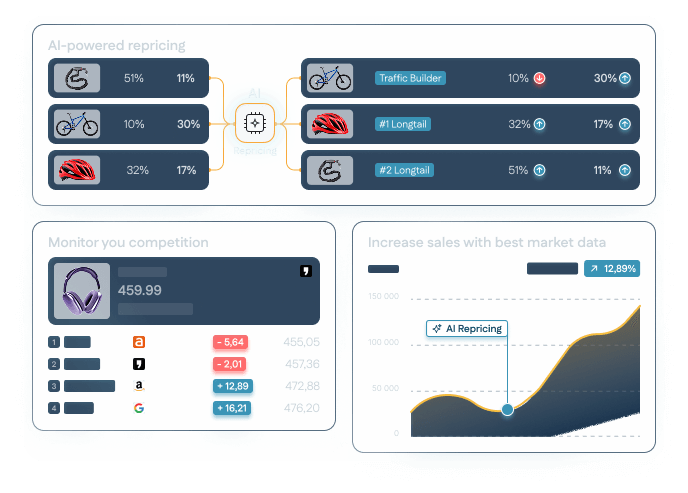
Built-in AI-powered repricing — from price monitoring to automated pricing decisions

How competitor price monitoring works

1

Collecting and matching

Online stores, marketplaces, and price comparison sites tailored to your product catalog.

2

Analysis and alerts

Monitoring on your schedule — alerts flag significant price changes.

3

AI-powered repricing

AI rules and recommendations keep margins and pricing at the appropriate level.

4

Reporting and Integration

Dashboards, exports, and APIs/feeds for your BI or ERP system.

Price Monitoring + Repricing AI

Price monitoring gives you an overview of the market. Repricing AI turns that overview into action—automatically adjusting prices within your rules and limits. Combining these two modules creates a pricing strategy based on data, not gut feelings.

Full transparency – A clear, intuitive dashboard for tracking results

Raport Google Shopping Price Monitoring — przykładowy dashboard z danymi cenowymi

Benefits of monitoring competitor prices

Find out how monitoring, alerts, AI, and data quality translate into higher margins.

A comprehensive overview of the market

Prices, availability, and promotions from all key channels—all in one place.

Instant price alerts

Get notified when prices or availability change—act before your competitors do.

Protection of MAP/MSRP and brand image

Enforce your pricing policy and detect unauthorized price reductions across all channels.

Time savings for the team

Automated monitoring and reporting — Your team can focus on strategy, not data collection.

Top-quality data

Clean, accurate, and regularly updated data you can rely on.

Integrations and Reporting

APIs, feeds, and pre-built reports—data flows to your tools and teams in real time.

App, program, or platform—which one should you choose?

Choosing a tool to monitor competitor prices depends on three things: how many products you’re tracking, how many channels you sell on, and whether the data needs to feed into your own systems. For a few dozen products, a spreadsheet will suffice. With thousands of SKUs and multiple marketplaces at once, you need a platform that does the work for you.

Number of products Frequency Integrations Workload Who is it for?
Worksheet Up to 50 By hand, once a week None A few hours per week Beginners, a few products
App 50–500 Once a day Limited Configuration + Overview A Growing Store, One Channel
B2B Platform 500–500,000+ Once a day to once an hour API, CSV, JSON, XML One-time setup + 24/7 system Multichannel, manufacturer, distributor

What to Look for When Choosing a Supplier — 6 Criteria:

  • Product Matching Accuracy
  • Data refresh frequency
  • Channel coverage
  • Data delivery method
  • Implementation support
  • Transparency of data sources

You don’t need thousands of products to get started.

When You Need a Platform — 3 Signs:

Your pricing manager spends more time collecting data than making decisions.

You sell through more than one channel.

You want to automate, not just monitor.

E-commerce leaders around the world have placed their trust in us

Retailers and brands in over 15 markets

Applications of price monitoring

When Does Price Monitoring Pay Off?

Price monitoring makes sense for 100 or more popular products. Below that threshold, you can manage prices manually faster than it takes to set up the system. Above that threshold, the time spent on manual monitoring costs more than the subscription fee.

What determines the cost?

Pricing for monitoring is determined on a case-by-case basis. Key factors:

  • the number of SKUs monitored,
  • the number of sales channels and markets,
  • data refresh frequency,
  • the scope of integration with your systems.

We don’t publish a price list—but you’ll receive a free demo and a personalized quote within 24 hours.

Is this a solution for a smaller store?

Yes. You don’t need thousands of products to get started. If you have more than 100 products, sell on at least two channels, and change your prices more than once a week—price monitoring will likely save you more time than it costs.

Input data
Enter details about your offer

"Must-have" products that generate the most revenue

E.g. Amazon, eBay, Google Shopping – don't count your own store

Your savings
Monthly savings from automation

Fill in the data and click "Calculate savings" to see the results

Assumption: checking one competitor's price takes on average 30 seconds

Frequently Asked Questions

Answers to frequently asked questions about price monitoring

Current price, promotional price, shipping cost, availability (in stock / out of stock), offer description, seller name, ratings and reviews, and the Omnibus price (lowest price from the last 30 days). All data comes with history – you can track how a competitor’s price changed over time.

Marketplaces (Amazon, Allegro, eBay, Kaufland, bol.com, eMAG), price comparison engines (Ceneo, Idealo, Google Shopping, Skroutz, PriceRunner, Heureka, Kelkoo), and individual online stores. In the standard model (CP), we use a fixed, tested set of platforms. In the dedicated model (BAU), we can add virtually any public source.

Over 30 markets in Europe and beyond – including Poland, Germany, Austria, France, the Netherlands, Czechia, Romania, Hungary, Italy, Spain, the United Kingdom, Scandinavian countries, and many more.

Once a day by default. In the premium model – up to 4 times a day. In the dedicated model (BAU) – as often as every hour, with the option to vary frequency per product group (e.g., 1,000 key SKUs every hour, the rest once daily).

The foundation is EAN/GTIN/MPN/ASIN codes. In the dedicated model, we also use manufacturer codes, product names, specs (weight, size, variant), and even images verified by QA. We maintain an internal dictionary of multi-packs and packaging variants – if a competitor sells a 3-pack and you sell a single unit, the system will tell them apart.

In the dedicated model (BAU), we can monitor virtually any online store with public prices. In the standard model (CP), we monitor marketplaces and price comparison engines – if your competitor is on Ceneo, Idealo, Google Shopping, or Amazon, we have them covered.

Yes. Allegro is one of our standard sources. We monitor prices, availability, number of offers, and position in search results. If you’re interested in deeper Allegro analysis (bestsellers, brand market share, product gaps) – check out our free Bestseller Radar.

From a few dozen to over 500,000 SKUs. There’s no upper limit. Monitoring makes sense starting from about 100 products – below that threshold, manual price checking is faster.

Yes – because it shows you where you’re lowering prices unnecessarily. Many of our clients discover they have products priced below every competitor, even though they don’t have to – because customers buy from them anyway due to brand, availability, or delivery. These products are “easy gains” – raising their price doesn’t impact sales but improves margin.

Yes, but from a different angle. Manufacturers use monitoring to enforce pricing policies (MAP/MSRP) – they check whether distributors and retailers are selling below agreed prices. It’s a brand protection tool, not a direct sales tool.

Scale and speed. Manually checking the price of one product at one competitor takes about 30 seconds on average. With 5,000 SKUs and 10 competitors, that’s over 400 hours of work per month. Dealavo does it automatically, daily, across all sources at once – and alerts you when something significant changes.

Yes. The system sends email notifications when a competitor’s price changes above a threshold you define. You can set alerts per product, per competitor, or per category.

Yes. Dealavo stores full price history from all monitored sources. You can compare price changes over time, identify seasonality, and analyze how competitors react to your price changes.

It won’t replace one – but it will change how it works. Instead of spending time manually collecting data, your team can focus on analysis and strategic decisions. If you don’t have a pricing team – monitoring combined with AI Repricing takes over the operational side of price management.

Dealavo’s Competitor Price Monitoring is a price monitoring tool that automatically collects data on competitor prices, availability and promotions from online stores, marketplaces and comparison sites. The system matches products by EAN/MPN to your catalog, analyzes changes and sends alerts when significant price movements are detected. Data is available in the dashboard, via API v3 or automatic feeds to your BI/ERP.

Competitor price monitoring is used by both large companies with their own pricing department (they buy data from us for their systems) and medium-sized online stores that combine monitoring with Repricing AI and automate pricing decisions. We operate in more than 30 countries – from Poland and DACH, to the UK and Scandinavian markets.

99% accuracy. We match products automatically by EAN, MPN and name, and every match goes through a QA team verification. The detector system detects anomalies – wrong prices, changes in availability, new offers – before they affect your decisions. Refresh frequency: from once a day to every hour.

Yes. You will pass monitoring data to your systems via API v3 or automatic feeds. We also have native integrations with e-commerce platforms: IdoSell, WooCommerce, Shopify, Magento 2, Baselinker. Our team supports the implementation from the technical side.

Dedicated account manager – a specialist
familiar with your industry, with a direct phone number. We support from onboarding
through the entire period of cooperation: source configuration, team training, assistance with
integrations. Setup time for standard sources is 24 hours.

Ready to revamp your pricing strategy?

Join hundreds of companies that are already using Dealavo to optimize their pricing and increase profits.

Demo within 24 hours
Send it now and see your revenue grow by up to 30% in the coming months
Dedicated onboarding specialist

Get Your Free Demo